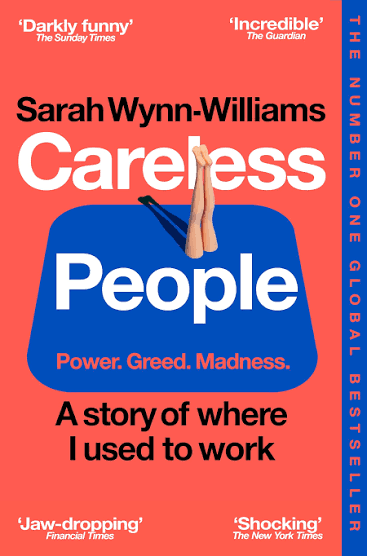
’Careless People’ — Book Review
Before I get into the meat and potatoes of this book, there’s something you should know.
I’m a bookaholic. Reviews will not be rare here.
I wish I could say that whilst sitting in a vintage leather Chesterfield near a roaring fire and surrounded by oak shelves full of physical books.
Sadly, I can’t. Small boats and small homes don’t allow for such luxury.
Necessity means the bulk of my library is digital.
- Eight hundred and fifty-six books on Kindle (started June 2011).
- Seventy-six books on Kobo (started Dec 2025).
- Getting on for 1000 books I can’t touch, smell, or see. Sad but true.
My tastes are eclectic but with a strong bias toward non-fiction. There’s no doubting that being able to browse the world’s biggest bookshop in the early hours of the morning whilst lying in bed has widened my reading horizons. One click purchase and instant delivery has added many books to my library that would otherwise never have made it there, I wish I could say all of them were wise investments; they weren’t. Books on Chaos Magic and Ancient astronaut theories purchased in the dark hours somehow lose their appeal come daylight.
I’ve reigned things in a bit since switching to Kobo. Their book store interface lacks the smooth tempting ease of Amazons. That’s forced me to be more selective.
So, ‘Careless People — A story of where I used to work’ wasn’t an impulse buy.
The book, written by Sarah Wynn-Williams, is a memoir about her years running global policy for Facebook. The blurb made clear that juicy secrets lay within, why else would Meta’s lawyers have tried to get the book suppressed?
Now I should flag my biases upfront here. I don’t use social media, and Facebook in particular has always struck me as one of the worst purveyors of this particular evil. So, I admit that I went into this book ready to believe the worst of the people who built it. That said, I’m also old and wise enough to know that ex-employees with a grudge may not be the most reliable source of accurate information.
But the more I read, the more I began to trust that Wynn-Williams might just be telling the truth. The phrase “you couldn’t make it up” kept springing to mind. I know that phrase is primarily British so let me elaborate, it’s applied to something so strange, ridiculous, unbelievable, or absurd that if you invented it as a story, nobody would believe you.
Some examples from the book:
Sheryl Sandberg (then Facebook’s Chief Operating Officer) could see no wrong in buying a kidney on the black market for her child if one were ever needed.
Joel Kaplan (Facebook’s Global Public Policy Chief) marked Wynn-Williams down at review time for being “unresponsive” to his messages (while she was in intensive care after childbirth complications).
Then there’s Zuckerberg himself. Brilliant though he may be as a software engineer, examples of him being completely out of touch with reality abound. He’s repeatedly described as unwilling to consider any briefing note longer than a single text message, and as a result commits numerous random and embarrassing acts on the global stage.
For example, at the United Nations he spontaneously promises that Facebook will provide internet access to refugees all over the world. Taken completely by surprise, various teams at Facebook then race around trying to figure out how to do it. The above-mentioned Kaplan then intervenes to insist that giving away free internet to refugees is a bad idea, and that instead, they should sell it to them.
Not long afterward the project dies when Kaplan fires off an email stating that he’s just realised that refugees don’t have any money!
Peaking behind the curtain of the super rich flitting around the globe on their private jets was always going to be entertaining. That Zuckerberg’s underlings suck up to him shouldn’t come as a surprise I guess. Letting him win at board games falling at the less dangerous end of the sycophantic spectrum.
There’s a revealing scene which takes place as Zuckerberg is about to board a flight to Peru. There’s a delay, he’s forgotten his passport. He immediately looks for someone to blame. Wynn-Williams says ‘I guess that’s what it’s like to live in a bubble, like Mark does. But a bubble implies flimsy transparency ….. where you can see normal life just beyond your grasp. The bubble Mark inhabits is more like a thick opaque dome that separates him from the rest of the world.’ She goes on to say that when you have so many other people doing things for you, you stop taking responsibility for anything. She finishes with; ‘This guy can’t even take responsibility for leaving his passport at home, let alone influencing the US election’.
That said, being out of touch with reality seems contagious to many close to Zuckerberg. One of his staffers suggests they contact the President of Peru to see if he’d allow him in without a passport!
All of this may be comedic but ultimately, what this book reveals is dark and worrying.
Facebook is a business with one simple aim; to make money.
They’ve become too big to jail and don’t care how they do it.
Their best customers are dictators and would-be dictators, promoters of hatred and genocide, authoritarians seeking opportunities to purge their opponents.
They hold an ever-growing cache of data about everything. Data that was previously completely private. Data on the citizens of every country. AI will allow them to access and use this data in ways that would have been unthinkable a few years ago. If information is power, Meta are now the most powerful company on earth.
‘Careless’ doesn’t cover it. Add reckless, indifferent, petty, spoiled, unaccountable, untouchable and dangerous.
As I said earlier, Facebook (Meta) is anathema to me. Reading this book confirmed my worst fears about them.
Meta stopped reporting Facebook-only monthly active users years ago, and now reports only a combined metric for Facebook, Instagram, Messenger and WhatsApp. The most recent figure I could find was 3.6 billion active users. Of those some 200 million are businesses.
Meta generated $60.8 billion in revenue in Q2 2026, overwhelmingly from advertising.
Perhaps you dear reader are one of those 3.6 billion. If so, I’d highly recommend reading this book.
The choices we make in life should be informed ones, this book may give you food for thought.