Longer Reads
Back to the Future
I first wrote online twenty years ago. In 2006, I started a WordPress blog to document my build of a 38ft ocean-going catamaran. It started as a purely selfish exercise. Building this boat was going to be a multi-year, life-changing task, and recording every step seemed an important thing to do. I blogged most every day, never thinking anyone else would see it. To my amazement, they did. Within a few months I’d gained a supportive and engaged little community. They commented. They advised. They encouraged. I may have been the only one with hands on the tools, but without these friends the boat may never have been finished.

As an aside, when, years later, I had to sell my dream, she was sold to someone from that little online community. They’re on the boat now, having crossed the world’s oceans.
Perhaps fading memory has painted a rosier picture, but it seems to me that life online was more enjoyable back then. Simple and fulfilling.
Let’s rewind to the year 2006
The phrase “social media” wasn’t yet in common use; people talked about “social networking” and “user-generated content”. Facebook was still a college and school network, Twitter had barely launched and was known only to a handful of tech types. There were no smartphone apps and no algorithmic feeds.
Blogger, MSN Spaces and WordPress were really your only options if you wanted to say something to the world.
I loved the idea of having my own little place on the internet. I enjoyed sending out a post before I went to bed and waking up to see comments and messages from folks on the other side of the planet.
I miss those days.
OK, there’s no escaping it. I’m getting on in years, and I’m falling into the trap of telling anyone who’ll listen that things were better back in the day. Every generation seems to do it, but mine will be the first to apply that nostalgia to the internet and digital technology.
I first put my fingers to a computer keyboard in 1999. The machine and screen took up most of my desk space. Connecting to the internet via a dial-up modem took minutes, and there wasn’t much you could do there even if you succeeded. But I was entranced by the magic of it all.
Now, only twenty-seven years later, we carry little devices in our pockets that instantly connect us to anyone, anywhere. We can get answers to any question, watch videos, listen to podcasts, read books, navigate the globe.
And the magic has gone.
Isn’t that strange?
So where did it go wrong?
The curse of enshittification
Earlier in the year I read Cory Doctorow’s book Enshittification. In it, he explains the predictable lifecycle of how a tech company goes from giving great service and being loved by its users to giving less value at greater cost, to the point of becoming annoying and disliked. And they can do this because users become “locked in”. The pain of leaving means they’ll put up with all this crap.
He’s spot on. I’ve seen this entire cycle play out time and time again.
That said, I’m too bullshit-intolerant to stick around when this happens to me.
Numerous WordPress sites have come and gone, even my personal one. With managed hosting beyond my reach, I got to the point where just keeping a site running cleanly became an annoying time suck. I wanted to be a writer, not a webmaster.
So I shifted to Medium, and at first it looked like I’d found a home. I posted regularly, I gained followers, and for the first time started earning money. I found myself thinking more and more about catchy titles, categories and my “target” audience. I wrote about Personal Knowledge Management (PKM) and got invites from a few publications. I monitored my stats and gained 1.4K followers. I started thinking I’d finally cracked it. But the inevitable enshittification soon shattered that idea. They changed the algorithms, they changed the agreements, and earnings plummeted. Of those 1.4K followers, few were reading, fewer still commenting. It became a meaningless number.
Once again I started looking for a new place, and found Substack.
My Substack journey
I posted my first article on Substack some 18 months ago. Initially, I tried to replicate what I’d been doing on Medium. I thought I’d write about my attempts at making money through writing online. Then I wrote a book about AI and figured I’d set up an accompanying Substack publication. If I’m honest, my heart wasn’t really in either of these things — I’d just become brainwashed into thinking there had to be a “purpose” to writing online. It took a while for me to realise that wasn’t true. It took a while to realise that what I really wanted to do was to write as I’d done all those years before. To just be myself.
So I switched to writing about my sailing, my life in Cornwall and whatever else came to mind.
I felt better about myself. And I felt better about Substack.
But gradually I noticed enshittification creeping in.
For me, it started with Substack Notes.
When I first came to Substack, the Notes feature seemed to be just a little add-on — useful for some, maybe, but of no interest to me. I ignored it and just focused on writing my posts. Now it’s seemingly become more important than actual posts. It’s impossible to avoid the plethora of Notes “growth hacking” material that, ironically, seems to fill most of the Notes timeline. I’ve worked hard to extract myself from this kind of swamp; I have no desire to walk a path leading back into it.
Some will say I’m overreacting. Some will say Notes is essential for growth. Some will say there’s no point writing if no one reads it. And they’re right — if that’s what they believe.
But honestly, it makes no difference to me and my life how many people are following me. In fact, I think it creates an unhealthy relationship with the community of people who read what I write. Turning conversations and relationships into cold metrics seems plain wrong to me. I’m not a number, and neither are you. No one you meet socially asks you how many friends you have and how many times they text you every day. That isn’t how people in real life measure other people’s social worth. It’s kind of weird when you think about it.
Then I read something that prompted me to do some digging into Substack’s investors.
I discovered that a firm called Andreessen Horowitz led several fund-raising rounds and holds a board seat. I found that the firm donated $39 million to Trump’s political machine, and that some of its former executives are now serving in the Trump administration. OK, this has nothing to do with Substack directly, but it left me uneasy.
Then, more research revealed that 1789 Capital, the venture firm co-founded by Donald Trump Jr., put money into Substack in 2024. 1789’s own site states that it explicitly invests in “anti-woke” media aligned with conservative values… hmmmm.
Now, whether all this really matters is open to argument. Substack’s case is that it’s always taken venture money from all directions, that no single investor dictates editorial policy, and that its hands-off approach to what gets published predates this fund-raising and applies regardless of who’s writing the cheques.
Critics see it differently. They see it as one more sign that a platform built on the promise of neutrality has, in practice, been drifting rightward for a while — this being just the clearest evidence yet.
I know this is contested, and I accept that your political leanings will alter your perspective. That’s fine — you can read the arguments on both sides and draw your own conclusions.
But for me, it’s simpler than an argument. Trump, and the network of people and money now orbiting him, are a red line for me. I unknowingly crossed that line because I didn’t do my homework. But now I know what I know, I don’t want my name and my work sitting on infrastructure they’ve put money into. That’s not a verdict on Substack. It’s just me making a stand.
It’s strange, looking back. I’d been feeling uncomfortable about Substack for months, and I’d stopped writing because my heart wasn’t in it. I thought it was me. Turns out it wasn’t. It was where I was writing.
Goodbye Substack.
What now?
To be honest, I came close to kicking this whole online writing game into touch. Could I really be bothered to start again somewhere else, only to go through all this again sometime down the road?
But there was no escaping it — I still wanted to write online. I still wanted to share. I still needed to feel part of a like-minded community.
And that gave me a question to answer: “Is there somewhere I can write, own my domain and content, and have a bit of community, but without being sucked into the machinery of billionaire-owned media companies?” To put it another way, is there a way to get back to that simpler, less shitty way of blogging I so fondly remember?
I’m pleased to report that the answer is “yes” — and you’re reading it.
A Question Answered?
This question has been rattling round my brain for a while now:
“Is there somewhere I can write, own my domain and content, have a bit of community, but without being sucked into the machinery of billionaire-owned social media? “
I’d begun to think the answer was “no”.
Then I discovered Mr Reece and his micro.blog platform.
I’ve learnt the hard way that first impressions (especially online) can often be but a mask. Once you see what’s hidden, crushing disappointment soon follows.
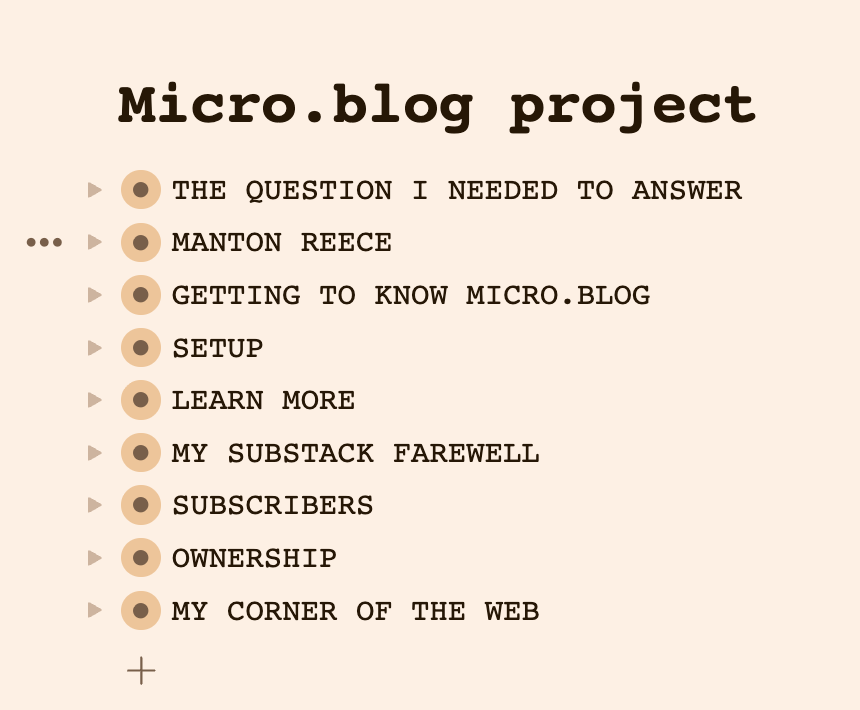
So I’m being cautious. I’m working slow. I’m taking time to think. My Workflowy project is getting bigger. I’m learning and experimenting.
But the more I see the more I’m beginning to wonder. Could it be there’s no mask here? Could it be I’ve finally found a place to call home? Could the answer to my question be “yes”!?