You Must Know What You Want
For a long time, I let other people and circumstances decide the direction of my life. I took the jobs, accepted the arrangements and tried to make the expected version of things work. I was doing what seemed sensible. More than once, I also got kicked in the teeth for it.
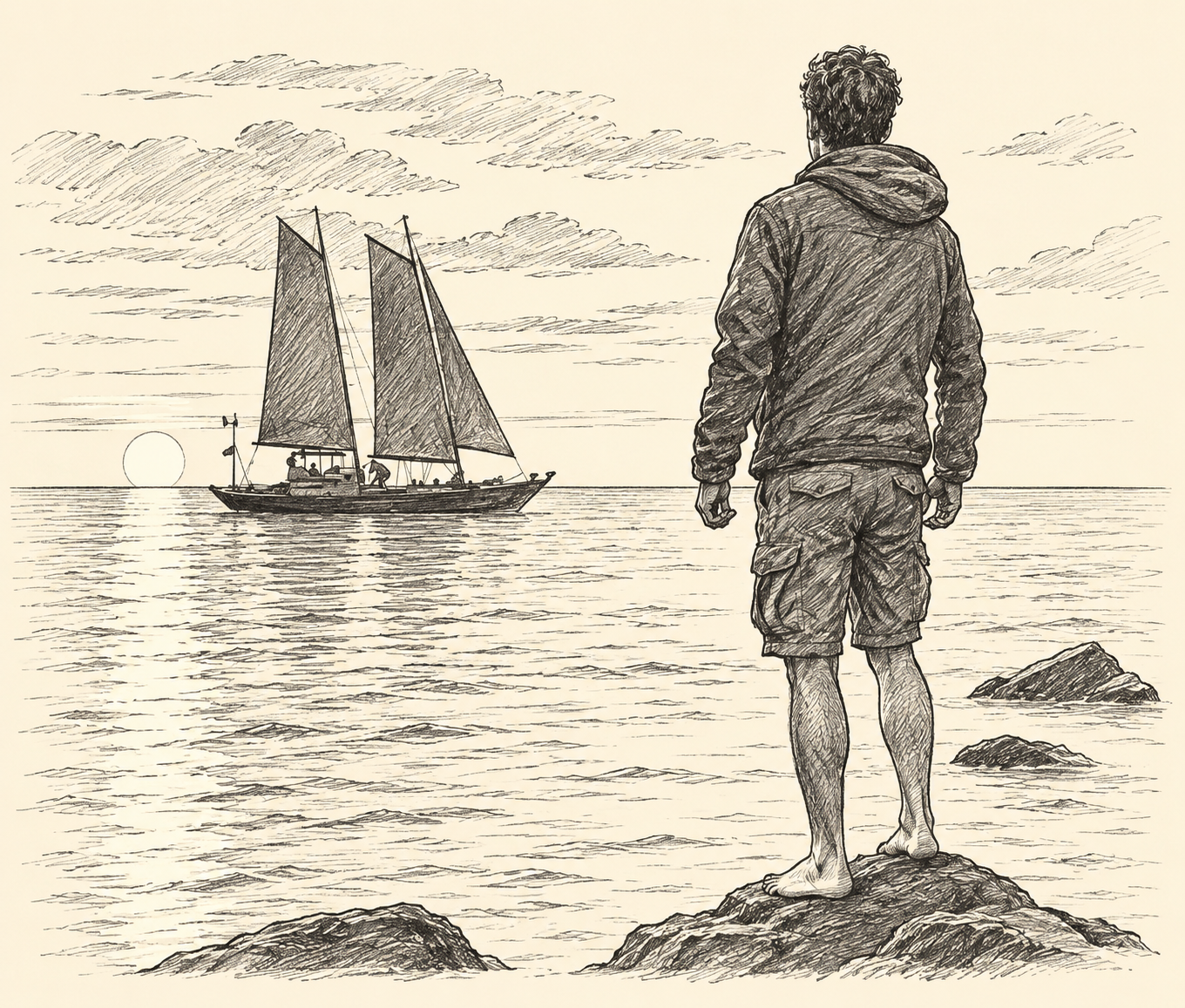
By 2006, I was worn down. A relationship had ended, and I found myself alone in a rented flat, asking how I had lost so much again. I didn’t have a neat plan for what came next. But somewhere beneath the hurt was a memory I could no longer ignore: the years I’d spent living aboard a little boat called ‘Mor Gwas’, and how alive and happy I’d felt then.
I’d lost that boat decades earlier. I’d returned to ordinary life and put the sailing dream away. Yet, it had never really gone. I began to understand that I didn’t simply want another boat. I wanted to recover some say in the shape of my own life.
That distinction mattered. “I want to be happy” is a feeling, not a direction. “I want to build a boat I can live aboard and sail away in” was something I could begin to investigate. It was specific enough to give me a next step, without pretending I knew every step after that.
I’d been fascinated by the Wharram catamarans since I first saw one in 1983. Now I studied the designs and chose a Tiki 38: a boat big enough to live on and designed for ocean sailing, but small enough for me to build by myself. I called her ‘Gleda’ an Old English name meaning ‘happiness’.
The choice was not a sudden leap into a ready-made adventure. I still had a job, little money and practical problems to solve. I needed somewhere to build within commuting distance of work, and I couldn’t afford an industrial unit. I searched, advertised and eventually found a barn less than five miles from my office. It leaked and needed work, but it was the right size, place and price. I bought the plans, nearly emptying my bank account, and started arranging the materials.
I remember how different I felt once I had committed. A few months earlier I’d felt lost. Now I had a purpose, a place to work and a project that was mine. I didn’t know exactly how it would all turn out. I did know what I was trying to do.
That didn’t make the years that followed easy. Building _‘Gleda’ _took more than seven years. There were cold nights in the barn, slow stretches when progress was hard to see, mistakes, materials problems, work pressures and plenty of moments when the project felt too big. I kept learning and adjusting. The boat grew one piece at a time: timber, plywood, epoxy, more sanding than I care to remember.
I’m not offering this as proof that wanting something makes it happen, or that everyone should abandon a secure life to pursue a dream. People have different responsibilities, resources and limits. My circumstances were my own, and I was fortunate in some ways as well as tested in others.
But I learned that it’s difficult to choose a direction if you haven’t first asked yourself where you actually want to go. If you don’t examine your own wants, familiar expectations can quietly supply them for you. You can spend years working towards a version of success that belongs to somebody else, without ever deciding whether it is the life you would choose.
Knowing what I wanted didn’t give me a guarantee. It gave me a way to judge the next decision. Would this move take me closer to the life I was trying to build? What could I do with the time, money and skills I had? What was one practical step I could take now?
In May 2014, after more than seven years of work, ‘Gleda’ was launched. Later, Gail and I sailed her down the Atlantic coast of Europe and into the Mediterranean. The voyage eventually ended, and I had to sell her. A dream coming true doesn’t mean you get to keep it forever. But building her changed how I saw myself and what I believed I could do.
When I look back, the most important moment wasn’t the day the boat touched the water. It was earlier, when I stopped treating my own desire as something foolish to be postponed, and began to take it seriously enough to act on it.
You don’t need to want a boat. You may not want to change your life at all. But it may be worth asking: What do I want, if I set aside for a moment what I’m supposed to want? The answer doesn’t have to be grand or dramatic. It only has to be yours.
You can’t choose a direction until you know what you’re moving towards. And you may not know for certain what lies ahead. I didn’t. I only knew that building ‘Gleda’ was the first thing in a long time that felt like my choice.