Longer Reads
The Night I Threw the TV Remote Across the Room
It had been dark, cold and raining when I’d stepped outside at 5:30 that morning.
It was dark, cold and raining now, 14 hours later.
Ten hours of driving and 4 hours of meetings. Truth be told they hadn’t really been meetings. Rather just opportunities for various people to complain, demand and shout at me.
I fumbled for the key to my rented flat, trying not to drop my takeout chow mein onto the doorstep.
Opening the door, I hit the light switch and dumped the food on the table. Grabbing a beer from the fridge, and a fork from the cutlery drawer, I walked into the lounge, pulling the ring tab as I went.
I collapsed on the sofa and slugged a mouthful from the can, eyes closed. My stomach rumbled. That Burger King lunch had been hours ago.
Ripping the lid off the foil container I forked a mouthful of noodles into my mouth and punched the TV remote.
Adverts, how do they do that? How is it possible to catch the commercial break every fucking time you switch on?
I switched channels, more ads. Unbelievable.
I kept pushing the button again and again, faster and faster. Channel after channel of shit. Shit, shit and more shit, everything’s shit.
I hurled the remote across the room. It hit the wall, the batteries flew across the floor.
I took another swig of beer and pushed my head back into the sofa, staring at the ceiling. How did I let this happen to me?
How can I have lost everything again? Is this how it’s going to be for the rest of my life? Is everything I ever do always going to go to shit? I
t’s all been for nothing. What’s the point?
The girl on the TV carried on rollerblading, apparently very happy with her sanitary pads.
Maybe I should just end it.
I got up and switched the TV off, then dumped the now cold chow mein in the kitchen bin. I couldn’t be bothered to shower, I was just so damned tired. Tears welled up. I left my clothes on the floor and pulled the duvet over my head.
The year was 2004.
I’d spent 20 odd years chasing the ordinary dream: a good job, a home, a family, a bit of leisure, and the happiness that’s meant to follow.
And I’d succeeded; twice.
As with all I’d ever done, I’d thrown myself into it, working all hours, fully committed, sure of myself.
Now, with two relationships, two homes, and two jobs lying in ruins I was left wondering if I was the problem.
Perhaps I’d been kidding myself. Perhaps I just wasn’t cut out to lead a ‘normal’ life.
The clues were there.
In my youth I’d bought a tired old 18ft sailboat and made her my home.
For two years I lived in an 8ft x 5ft space with a Primus stove for cooking, a chemical toilet, and a single narrow bunk for my sleeping bag.
Crazy enough some might say. But despite only ever having sailed dinghies before, I chose to take her to sea, sailing single-handed down the south coast to Falmouth. By the time I got there I’d pretty much figured it out.
A tiny sailboat was my home, the world was my oyster, and I was the happiest I’d ever been.
But I wanted more.
So I sailed my little boat south, heading for Spain.
It didn’t go well. I nearly lost my life, I lost my boat and I lost my purpose.
That’s when conformity pulled me back in.
And I’d given it a damn good shot hadn’t I? Surely, no one could question that?
Now here I was, 47 years old and right back where I started.
Only two paths lay before me.
One — give up. Call it quits. End it.
Two — accept that conformity wasn’t for me and find a way back to the sea.
Twenty-odd years on, I’m glad I chose the second path.
The man under that duvet couldn’t see what I can see now. What felt like the end of everything was only the end of a plan that was never really mine.
Paddling Through History
To celebrate the start of a new oyster season I dug out this archived post from 2023.
November isn’t a great month for getting out on the water down here in Cornwall.
Carrick RoadGales sweep in from the Atlantic on a weekly basis. Strong wind warnings become the norm.
My little sea kayak ‘Bucca’ handles the waves well. But I’m not a thrill seeker, I paddle for pleasure. So opportunities to get out are infrequent at this time of year.
But this week a brief lull allowed me to paddle for a couple of hours on the sheltered waters of the Carrick Roads.
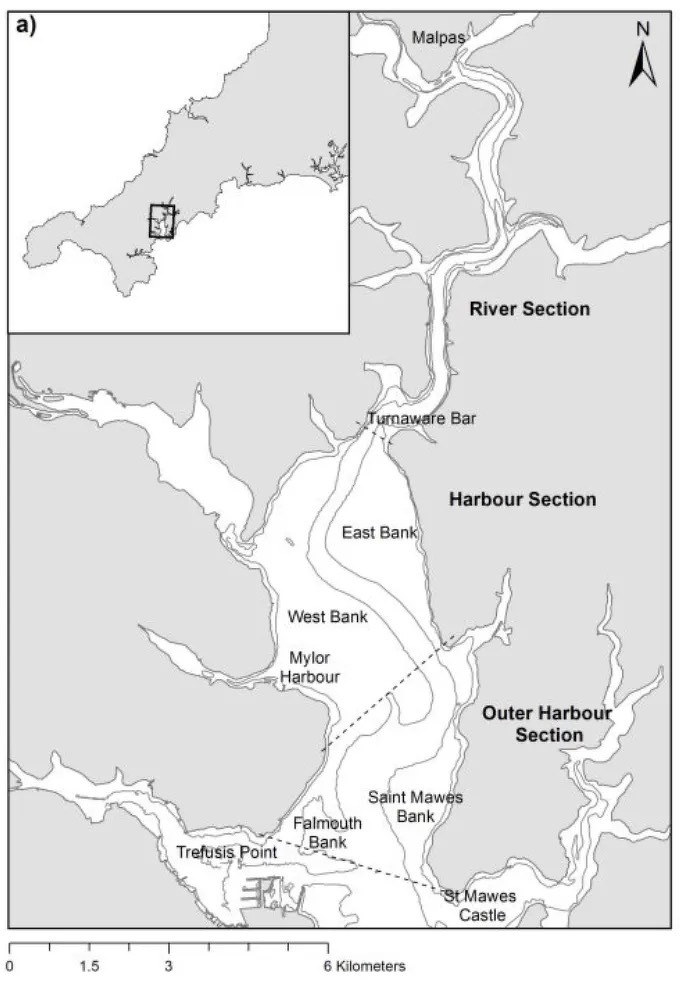 The Carrick Roads
That meant that once again I was able to enjoy seeing one of my favourite sailing craft.
I’m talking about the Fal Oyster Boats, also known as Falmouth Working Boats.
And I’m privileged to be able to see them. Why?
Because it’s the last oyster fishery in Europe to dredge using sail power alone.
And it’s been going on for a while.
The Phoenicians and Romans collected oysters right here thousands of years ago.
By that standard, the present-day oyster boats are a recent addition. They’ve only been going since 1868.
That’s when the Truro Corporation first passed the bylaw that’s still adhered to today.
The terms of its licence states:
“This licence does not extend to any boat while that boat is being propelled by mechanical power”.
It also stipulates when the work can take place.
The season starts at the beginning of October and runs until the end of March. Working time is limited to between 9 am and 3 pm on weekdays, 9 am to 1 pm on Saturdays and not at all on Sundays.
Who said enforcing stability and sustainability is a recent thing?
That there is still a healthy stock of native oysters in the Fal proves it’s worked.
What’s more amazing is that some of the original boats built to ply these waters are still working today.
Take the ‘Evelyn’.
She was built in 1898 on a beach in Restronguet Creek by master shipwright Frank Hitchens.
She’s still afloat and celebrated her 125th anniversary this year. And she isn’t afloat as just a museum piece either. She works the oyster beds in the season and races in the Summer.
Here’s a photo of her chasing down another boat whilst racing past Pendennis Castle in Falmouth. If a 125-year-old boat sailing in front of a castle built by Henry VIII over 450 years ago isn’t living history, I don’t know what is.
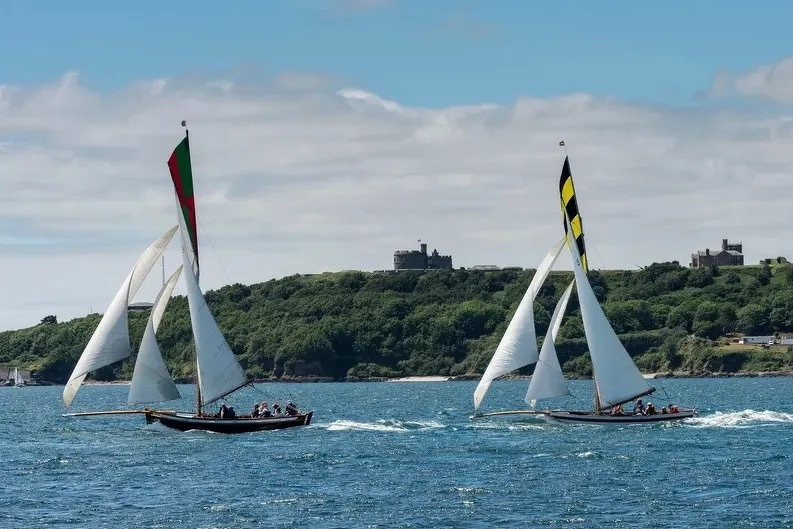 Photo from the Evelyn website
At its height in 1922, there were some 189 oyster boats operating on the Fal. Forty-five of those were sail powered and 144 relied on oars.
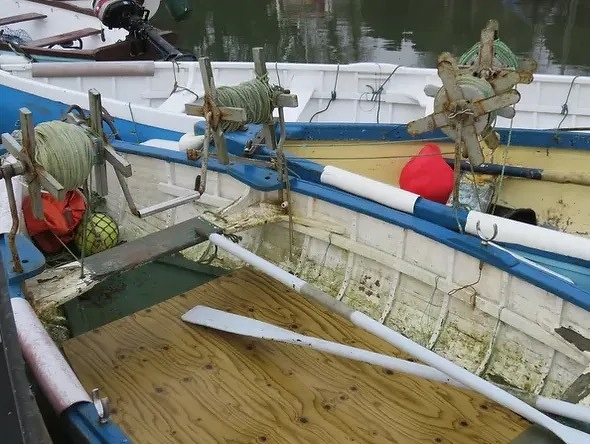
These rowboats were built specifically for the oyster dredging trade, and are known as haul–tow punts.
Usually worked by one person the fishing procedure involves dropping an anchor, rowing away from it, and then hauling the boat back towards it whilst dragging the dredge along the bottom.
The two drums you can see in the photo below control the anchor and dredge.
A survey carried out a few years back showed that there are now just 16 registered working boats and 14 registered haul-tow boats. Of those, it’s thought that only about 6 of the sailboats and 5 of the haul-tow boats are actively working.
On my paddle the other day there were about six out sailing and one haul-tow operating so that seems about right.
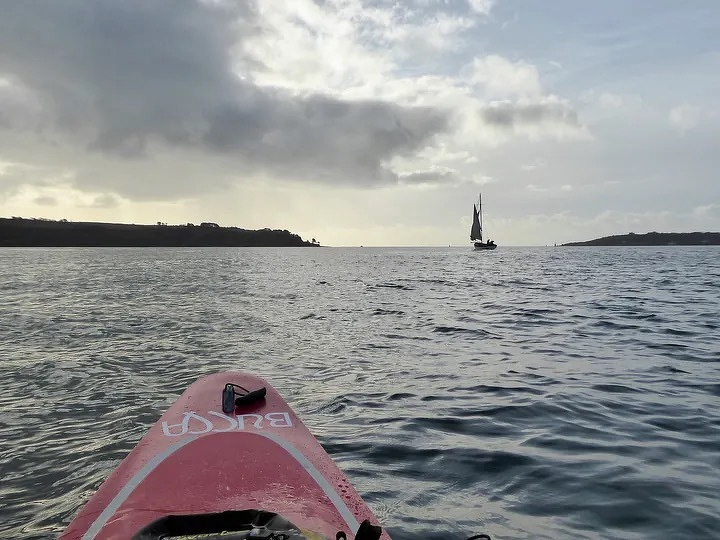
In some ways, it’s remarkable that there were any out there at all. A combination of Brexit and the COVID-19 pandemic all but finished the tradition.
It’s my understanding that more queen scallops (queenies) than oysters are now being dredged. And that storage and processing changes have had to be made to continue exporting to the EU.
I can’t pretend to know much about the intricacies of running a shellfish business.
I just know that the romantic sailor in me appreciates the beauty of these boats and the skill of the skippers who sail them.
Handling a heavy 28ft gaff-rigged sailboat solo when the breeze is fresh is not easy. That they do it whilst hauling dredges and sorting the catch is more impressive still.
The way they control things is to ‘scandalise’ the main sail to reduce the speed of the boat. In effect, they ‘heave to’. This means the boat can be left to look after herself leaving the skipper free to work.
At the end of a run, he then hauls the sail back up, sheets in, and re-positions the boat ready for the next one. That’s hard physical work.
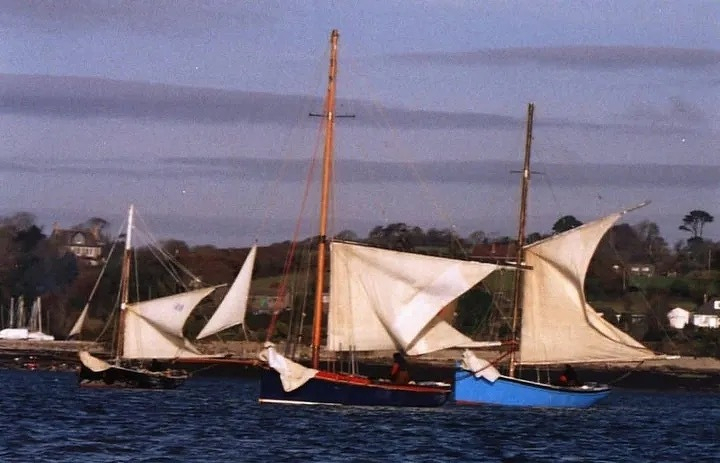 Three working boats with ‘scandalised’ sails
Who knows how much longer these skills will survive? The industry is resilient but there may come a time when its activity becomes financially unsustainable.
Whatever happens, it looks as if the boats will continue to sail. The Falmouth Working Boats Association has 25 boats registered. Not all are as old as Evelyn, some are even made of GRP.
But they are used. Summer races are regular and competitive.
Hopefully, these wonderful craft will be seen on the waters of the Fal for another 125 years.
I Built an Ocean-going catamaran. I’m Still Not Sure How
A tale of productive insanity
It’s nearly twenty years since a rag-eared ring bound little book fell out of a box I was unpacking.
I’d been working in a kind of numbness, trying to stay busy, trying to ignore the shit my mind was attempting to feed me.
Then there it was, like a beam of sunlight piercing the darkness. I smiled for the first time in ages. I picked it up, sat in my chair and started flicking through the pages.
A spark flashed.
The fire caught.
It saved me.
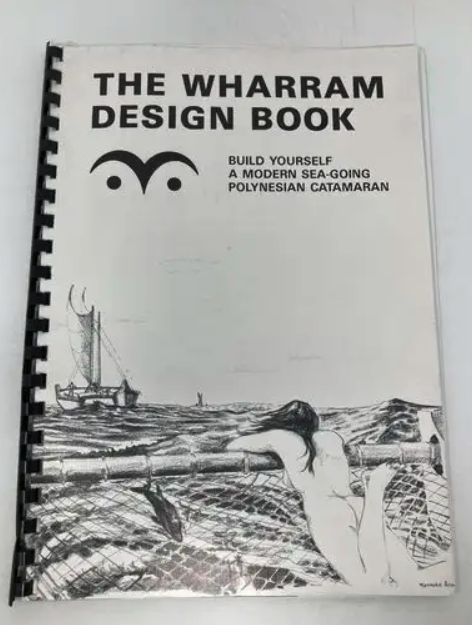
Within days, I’d chosen one of the designs; a Tiki 38 catamaran. 38ft (11.6m) length, 22ft (6.2m) wide, 3.5 tons (3000 kg) weight, capable of crossing oceans. Within a week, I had the study plans, the week after that I ordered the full build plans. Several hundred pounds I could ill afford. But I’d made a decision and I needed to commit.
I’d no money for materials.
I’d no place to build.
I’d no idea what I was doing.
I just knew I had to find a way.
There’s a well-known quote from W. H. Murray the Scottish mountaineer and author, it goes like this:
Concerning all acts of initiative (and creation) there is one elementary truth, the ignorance of which kills countless ideas and splendid plans: that the moment one definitely commits oneself, then providence moves too. All sorts of things occur to help one that would not otherwise have occurred. A whole stream of events issues from the decision, raising in one’s favour all manner of unforeseen incidents and meetings and material assistance which no man would have dreamed would come his way. I have learned a deep respect for one of Goethe’s couplets: “Whatever you can do, or dream you can, begin it. Boldness has genius, magic, and power in it. Begin it now.
Over the months and years that followed the truth in those words would be proved time and time again.
By the autumn of 2006 I’d found an old barn to rent close to where I worked and lived. I’d scraped together enough money to buy a pallet of plywood. I laid a chipboard floor, got my tools together and one cold, dark December night I cut the first two pieces of plywood (the skegs).
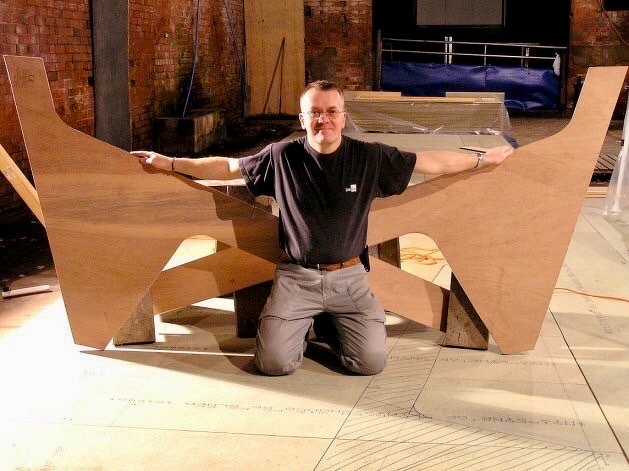 December 2006. The first pieces
Somehow, someway, I’d started building a boat. I started blogging. ‘The Gleda Project’ had begun.
Everyone thought I was crazy; They were right. A sane sensible person plans, budgets, makes pros and cons lists, thinks things through.
I didn’t do any of that, I just started.
That’s probably why it took me eight years and nearly 5,000 hours of work to get her on the water. It was a period of productive insanity.
Fatigue, illness, lack of money, work, family and more slowed me down or stopped me altogether. One year I only managed 46 hours of work on the boat.
Here’s another quote I learned the truth of. It’s from Arthur Ransome’s book Racundra’s Last Cruise written in 1928.
When it comes, the desire to build a boat is one of those that cannot be resisted. It begins as a little cloud on a serene horizon. It ends by covering the whole sky so that you think of nothing else.
If I’d thought about the project too much before I’d started, well, I’d never have started.
But here’s what’s interesting. Only a few months in and with not a lot to show, I’d already reached the point where abandoning the whole idea would have given me far more pain than continuing.
For years the goal stubbornly remained too far over the horizon to see. The work became the goal, step-by-step, doing what I could when I could. Each piece of wood cut, each pot of epoxy mixed, each inch of fibreglass sanded.
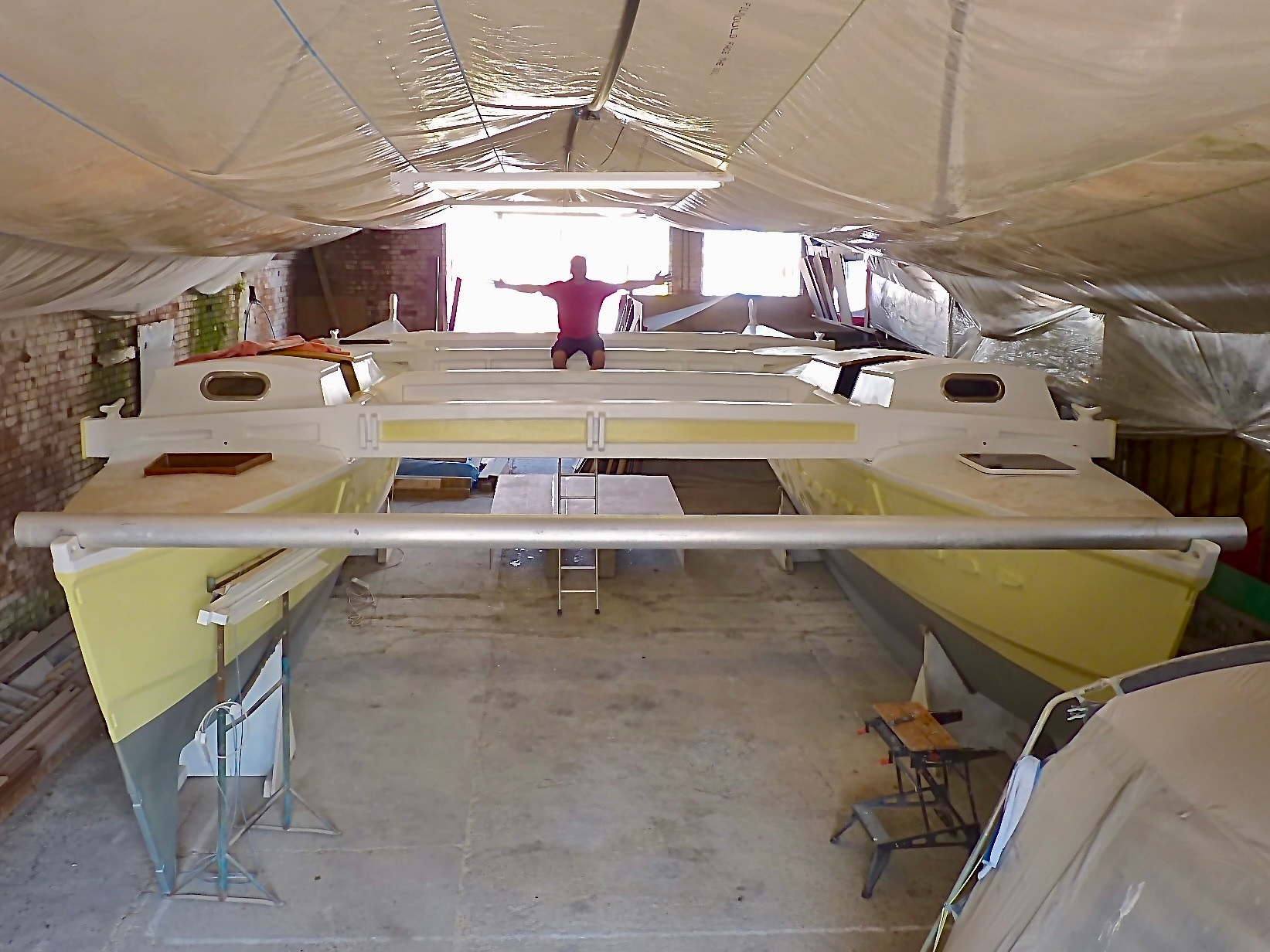 2013 - The hulls joined for the first time
But that said, on many dark wet, windy nights in the barn a vision came into my head. A vision of this thing I was creating floating on the open ocean, carrying me safely to new and exciting places, giving me adventures and experiences that would last a lifetime.
I’m proud to say dear reader that my dream became a reality.
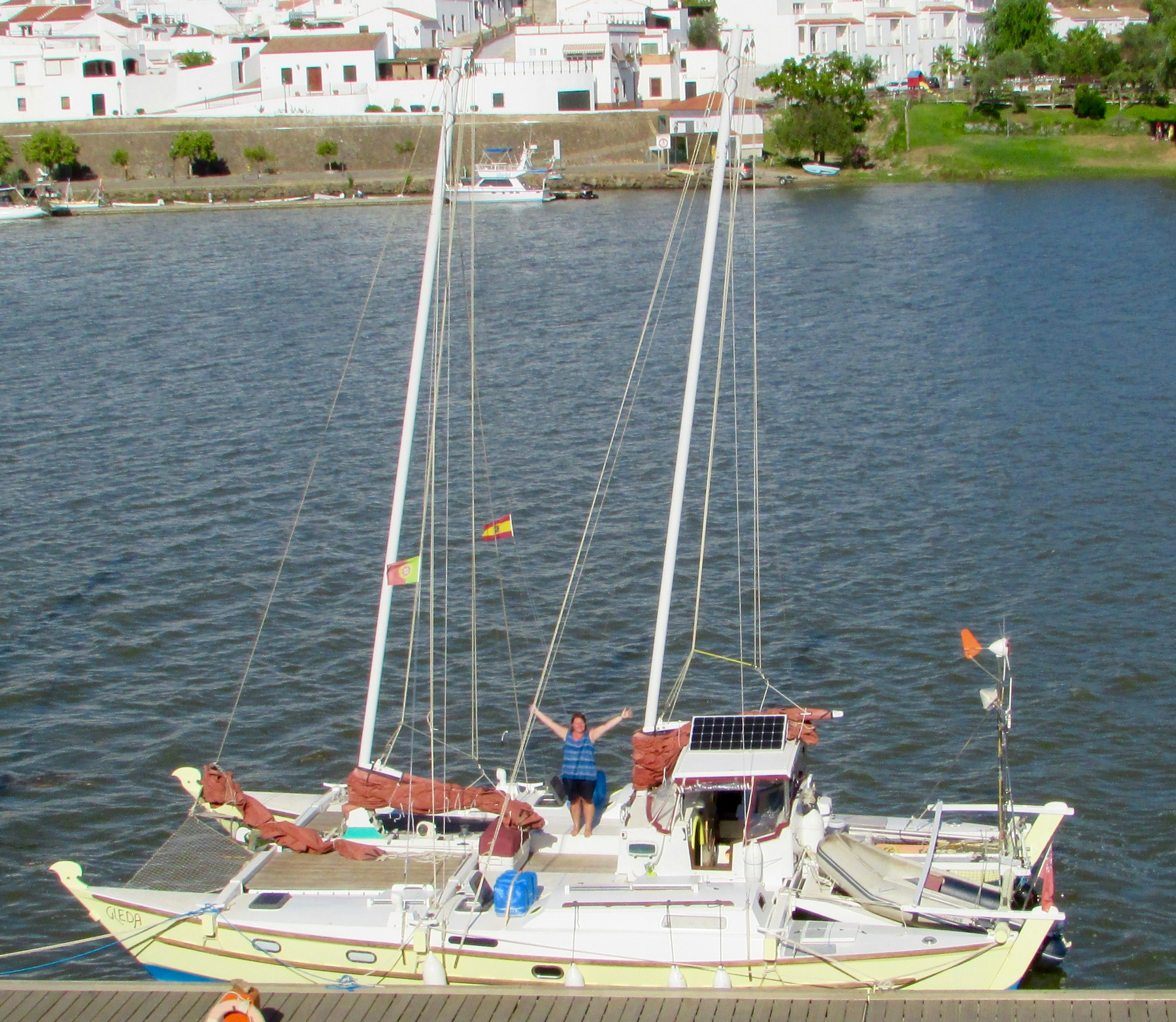 Gleda on the Portuguese side of the Rio Guadiana in 2016
Gleda is no longer mine. I sold her in 2018 to a German guy who’d followed the build since the start.
He and his wife are in Indonesia now. They’ve crossed the Atlantic and Pacific oceans on her.
I wish I could time-travel back twenty years. I wish I could find that crazy guy kneeling on the floor of a cold dark barn holding two pieces of plywood. I wish I could whisper in his ear, tell him his dream would come true, tell him he’d pass it on to others.
Building a boat taught me many things. One lesson in particular stays with me.
Whatever it is you want to do, start. Because you never know where it’ll finish.
 Gleda in the Pacific 2026 (bottom centre) - Photo courtesy of Michael Stephani
I use Bluesky because it feels like social media used to: you follow people, you see what they post. No Musk, no algorithm shoving sex, violence and racism in your face. I’m there to connect with readers and peers, not to chase reach, and for that it’s hard to beat. Maybe you’d like to join me there
I'm 70 next February, and I'm starting over (again)
I’m 70 in February. I live in Cornwall on a state pension, and I’m starting over (again).
The pension pays the bills. Just. There’s no safety net, and one letter from a government I didn’t vote for could take it away. I’ll come back to why that matters because it’s the whole reason I’m writing this in public.
First, how I got here. I’ve restarted my life more than a few times, and not always by choice. The first time was the easiest.
I was 26. I rolled my rally car three or four times into a ditch and wrote it off, and rallying, the one thing I loved, was over. Weeks later the new manager at work screamed at me in a glass office, in front of a customer, and sacked me on the spot. I took the company to an industrial tribunal. Two barristers, and me, defending myself because nobody knew what had happened in that office better than I did. I won. They gave me a payout, not huge, but more money than I’d ever had in my hands.
I spent it on a 18ft sailboat called Mor Gwas instead of another car.
I’d read a book about a man who crossed oceans in a similar boat, and I decided I could do the same. After many adventures, I set off from Falmouth. Three days out I was a wreck: seasick, exhausted, unable to eat, and with worse weather coming and no way of calling anyone. Then a French fishing boat appeared. I fired a flare. They came alongside and pulled me off.
Mor Gwas was up to the trip. I wasn’t. She stayed afloat, and the French Navy salvaged her days later. She went to a Frenchman in Brest, and I went back to my parents’ house with nothing. For weeks afterward strangers would say “oh, you’re the one that got shipwrecked,” and I’d let them say it because I was too ashamed to correct them.
That’s what it feels like when something you’ve gone all in on doesn’t work.
Then came another fresh start. I did what people do. I got a job. I got married. We bought houses. First a little semi, then a tiny 220-year-old cottage. A baby came along. We bought a new-build, with three bedrooms and an ensuite. I worked in a warehouse. Left home at 5:30 in the morning, got home 7 at night. In 1991, the company I worked for went bust because an accounting firm couldn’t add up. Liquidators, chains on the gates, everyone laid off. Interest rates hit 15%. I paid the mortgage with a credit card. House prices were falling, My wife left me taking our daughter with her. The house sold for £30,000 less than we’d paid two years earlier.
I clawed my way back. Another relationship, another house. This time I thought it’d be OK. It wasn’t. A few years later everything fell apart again. I thought that was the end of me.
It wasn’t. It was another beginning, though I didn’t know it for months.
By 2005 I was nearly 49, living alone in a rented flat, driving a thousand miles a week, meetings that were people shouting at me. I came home late one night with a takeaway chow mein, put the television on, then threw the remote across the room hard enough to smash it. I sat there staring at my food and once again wondering whether there was any point carrying on.
In January 2006, I finally cut open a box of books that had been sitting unopened since I’d moved, and in it was a book of sail boat designs. My heart leapt at the sight of it. Something in me that had been switched off for twenty years came back on, and I knew, not hoped, knew, that I was going to build a boat and get back to the sea.
It felt like my last chance. I’d rolled the dice and lost so many times before. If I failed at this, my life would be over.
I was 50 when I started. I had no money, no build shed, no idea. I found a barn in the middle of England, more than a hundred miles from the sea, and I spent eight years building a 38ft ocean-going catamaran in it. I blogged most days of the build.
Some years I logged over 700 work hours. One year I logged 46. I came close to giving up more than once. But I kept going, and after 5000 hours my boat tasted salt water for the first time.
I’d built alone, but I didn’t have to sail alone, I’d finally chosen the right girl, and so we sailed south together. I wrote and published three books about my boats and my adventures. I became ‘Foolish Neil’ and folks I’d never met recognised me and said ‘hi’. I’d deliberately built a boat, and along the way I’d accidentally built a community and an identity. All because I wrote and shared.
I’d planned for it all to continue. The Universe had other ideas.
After four wonderful years I sold my dream boat to a man who’d been reading my blog from the beginning. The decision to sell was mine, the reasons for having to do so beyond my control.
We bought a fifth wheel caravan and a truck, hoping to keep travelling, while still being able to respond if family needed us. COVID-19 and Brexit between them took that plan apart. An old dilapidated park home came up near my Dad’s place, so we bought it, I spent three months making it liveable, and we moved in during March 2021.
Another life change. One of the few open to us.
And not long afterward I found out the thing I’ve been living with ever since. I didn’t know who I was any more.
I write. I’ve always written. I’ll continue to write.
Almost everything good that has happened to me came from writing stuff down where people could find it.
The boat got finished because strangers on the other side of the planet helped me. They couldn’t be there to cut wood or mix epoxy, but nonetheless the boat would never have floated without them.
It’s taken far too long to realise that sharing who I am and what I do is an important part of my life. Sharing like this helps me understand myself better, helps me keep things in perspective, helps me get along. But, just as importantly, it connects me with others and, so they say, helps them too.
I’ve set up a new home online.
You’ll find it at www.neilhawkesford.co.uk. I’ll be writing about life in Cornwall on a small pension, and about the good things that come when you share it with strangers.
There’ll be daily ’micro posts’ and longer posts twice a week.
If you don’t want to miss those longer ones you can subscribe to get them by email.
So now you know who I am, and what to expect. Honest, a bit raw, and, dare I say it, even a bit foolish?
Which brings me back to the pension. It pays the bills, just. The way things are going it may not do so much longer. So I won’t pretend I’m not hoping this writing online lark might one day bring in a little extra. Even £500 a month would make a huge difference. Maybe it stays a blog. Possibly, it grows into something more. I honestly don’t know, and I’ve stopped needing to.
What I do know is that almost everything good in my life came from being open about it. So I’ll write often. I’ll share what I find, the good and the bad. And I’ll listen, which matters just as much.
Because I’m not the only one with a story like this. You’ve had your own changes too I’m sure. Some you chose, some were forced on you. Some turned out well, some badly. But every one of them brought you to where you are today, and the best bit is that you can always make a new choice. Even a small one. Mine happens to be starting a new blog.
So tell me about yours. I’d really like to hear.
You can email me direct - neil@neilhawkesford.co.uk
’Careless People’ — Book Review
Before I get into the meat and potatoes of this book, there’s something you should know.
I’m a bookaholic. Reviews will not be rare here.
I wish I could say that whilst sitting in a vintage leather Chesterfield near a roaring fire and surrounded by oak shelves full of physical books.
Sadly, I can’t. Small boats and small homes don’t allow for such luxury.
Necessity means the bulk of my library is digital.
- Eight hundred and fifty-six books on Kindle (started June 2011).
- Seventy-six books on Kobo (started Dec 2025).
- Getting on for 1000 books I can’t touch, smell, or see. Sad but true.
My tastes are eclectic but with a strong bias toward non-fiction. There’s no doubting that being able to browse the world’s biggest bookshop in the early hours of the morning whilst lying in bed has widened my reading horizons. One click purchase and instant delivery has added many books to my library that would otherwise never have made it there, I wish I could say all of them were wise investments; they weren’t. Books on Chaos Magic and Ancient astronaut theories purchased in the dark hours somehow lose their appeal come daylight.
I’ve reigned things in a bit since switching to Kobo. Their book store interface lacks the smooth tempting ease of Amazons. That’s forced me to be more selective.
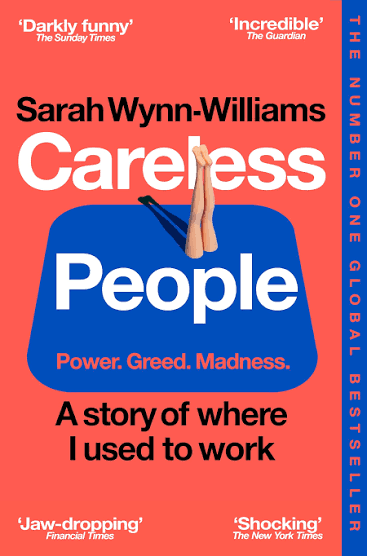
So, ‘Careless People — A story of where I used to work’ wasn’t an impulse buy.
The book, written by Sarah Wynn-Williams, is a memoir about her years running global policy for Facebook. The blurb made clear that juicy secrets lay within, why else would Meta’s lawyers have tried to get the book suppressed?
Now I should flag my biases upfront here. I don’t use social media, and Facebook in particular has always struck me as one of the worst purveyors of this particular evil. So, I admit that I went into this book ready to believe the worst of the people who built it. That said, I’m also old and wise enough to know that ex-employees with a grudge may not be the most reliable source of accurate information.
But the more I read, the more I began to trust that Wynn-Williams might just be telling the truth. The phrase “you couldn’t make it up” kept springing to mind. I know that phrase is primarily British so let me elaborate, it’s applied to something so strange, ridiculous, unbelievable, or absurd that if you invented it as a story, nobody would believe you.
Some examples from the book:
Sheryl Sandberg (then Facebook’s Chief Operating Officer) could see no wrong in buying a kidney on the black market for her child if one were ever needed.
Joel Kaplan (Facebook’s Global Public Policy Chief) marked Wynn-Williams down at review time for being “unresponsive” to his messages (while she was in intensive care after childbirth complications).
Then there’s Zuckerberg himself. Brilliant though he may be as a software engineer, examples of him being completely out of touch with reality abound. He’s repeatedly described as unwilling to consider any briefing note longer than a single text message, and as a result commits numerous random and embarrassing acts on the global stage.
For example, at the United Nations he spontaneously promises that Facebook will provide internet access to refugees all over the world. Taken completely by surprise, various teams at Facebook then race around trying to figure out how to do it. The above-mentioned Kaplan then intervenes to insist that giving away free internet to refugees is a bad idea, and that instead, they should sell it to them.
Not long afterward the project dies when Kaplan fires off an email stating that he’s just realised that refugees don’t have any money!
Peaking behind the curtain of the super rich flitting around the globe on their private jets was always going to be entertaining. That Zuckerberg’s underlings suck up to him shouldn’t come as a surprise I guess. Letting him win at board games falling at the less dangerous end of the sycophantic spectrum.
There’s a revealing scene which takes place as Zuckerberg is about to board a flight to Peru. There’s a delay, he’s forgotten his passport. He immediately looks for someone to blame. Wynn-Williams says ‘I guess that’s what it’s like to live in a bubble, like Mark does. But a bubble implies flimsy transparency ….. where you can see normal life just beyond your grasp. The bubble Mark inhabits is more like a thick opaque dome that separates him from the rest of the world.’ She goes on to say that when you have so many other people doing things for you, you stop taking responsibility for anything. She finishes with; ‘This guy can’t even take responsibility for leaving his passport at home, let alone influencing the US election’.
That said, being out of touch with reality seems contagious to many close to Zuckerberg. One of his staffers suggests they contact the President of Peru to see if he’d allow him in without a passport!
All of this may be comedic but ultimately, what this book reveals is dark and worrying.
Facebook is a business with one simple aim; to make money.
They’ve become too big to jail and don’t care how they do it.
Their best customers are dictators and would-be dictators, promoters of hatred and genocide, authoritarians seeking opportunities to purge their opponents.
They hold an ever-growing cache of data about everything. Data that was previously completely private. Data on the citizens of every country. AI will allow them to access and use this data in ways that would have been unthinkable a few years ago. If information is power, Meta are now the most powerful company on earth.
‘Careless’ doesn’t cover it. Add reckless, indifferent, petty, spoiled, unaccountable, untouchable and dangerous.
As I said earlier, Facebook (Meta) is anathema to me. Reading this book confirmed my worst fears about them.
Meta stopped reporting Facebook-only monthly active users years ago, and now reports only a combined metric for Facebook, Instagram, Messenger and WhatsApp. The most recent figure I could find was 3.6 billion active users. Of those some 200 million are businesses.
Meta generated $60.8 billion in revenue in Q2 2026, overwhelmingly from advertising.
Perhaps you dear reader are one of those 3.6 billion. If so, I’d highly recommend reading this book.
The choices we make in life should be informed ones, this book may give you food for thought.
Back to the Future
I first wrote online twenty years ago. In 2006, I started a WordPress blog to document my build of a 38ft ocean-going catamaran. It started as a purely selfish exercise. Building this boat was going to be a multi-year, life-changing task, and recording every step seemed an important thing to do. I blogged most every day, never thinking anyone else would see it. To my amazement, they did. Within a few months I’d gained a supportive and engaged little community. They commented. They advised. They encouraged. I may have been the only one with hands on the tools, but without these friends the boat may never have been finished.
As an aside, when, years later, I had to sell my dream, she was sold to someone from that little online community. They’re on the boat now, having crossed the world’s oceans.
Perhaps fading memory has painted a rosier picture, but it seems to me that life online was more enjoyable back then. Simple and fulfilling.
Let’s rewind to the year 2006
The phrase “social media” wasn’t yet in common use; people talked about “social networking” and “user-generated content”. Facebook was still a college and school network, Twitter had barely launched and was known only to a handful of tech types. There were no smartphone apps and no algorithmic feeds.
Blogger, MSN Spaces and WordPress were really your only options if you wanted to say something to the world.
I loved the idea of having my own little place on the internet. I enjoyed sending out a post before I went to bed and waking up to see comments and messages from folks on the other side of the planet.
I miss those days.
OK, there’s no escaping it. I’m getting on in years, and I’m falling into the trap of telling anyone who’ll listen that things were better back in the day. Every generation seems to do it, but mine will be the first to apply that nostalgia to the internet and digital technology.
I first put my fingers to a computer keyboard in 1999. The machine and screen took up most of my desk space. Connecting to the internet via a dial-up modem took minutes, and there wasn’t much you could do there even if you succeeded. But I was entranced by the magic of it all.
Now, only twenty-seven years later, we carry little devices in our pockets that instantly connect us to anyone, anywhere. We can get answers to any question, watch videos, listen to podcasts, read books, navigate the globe.
And the magic has gone.
Isn’t that strange?
So where did it go wrong?
The curse of enshittification
Earlier in the year I read Cory Doctorow’s book Enshittification. In it, he explains the predictable lifecycle of how a tech company goes from giving great service and being loved by its users to giving less value at greater cost, to the point of becoming annoying and disliked. And they can do this because users become “locked in”. The pain of leaving means they’ll put up with all this crap.
He’s spot on. I’ve seen this entire cycle play out time and time again.
That said, I’m too bullshit-intolerant to stick around when this happens to me.
Numerous WordPress sites have come and gone, even my personal one. With managed hosting beyond my reach, I got to the point where just keeping a site running cleanly became an annoying time suck. I wanted to be a writer, not a webmaster.
So I shifted to Medium, and at first it looked like I’d found a home. I posted regularly, I gained followers, and for the first time started earning money. I found myself thinking more and more about catchy titles, categories and my “target” audience. I wrote about Personal Knowledge Management (PKM) and got invites from a few publications. I monitored my stats and gained 1.4K followers. I started thinking I’d finally cracked it. But the inevitable enshittification soon shattered that idea. They changed the algorithms, they changed the agreements, and earnings plummeted. Of those 1.4K followers, few were reading, fewer still commenting. It became a meaningless number.
Once again I started looking for a new place, and found Substack.
My Substack journey
I posted my first article on Substack some 18 months ago. Initially, I tried to replicate what I’d been doing on Medium. I thought I’d write about my attempts at making money through writing online. Then I wrote a book about AI and figured I’d set up an accompanying Substack publication. If I’m honest, my heart wasn’t really in either of these things — I’d just become brainwashed into thinking there had to be a “purpose” to writing online. It took a while for me to realise that wasn’t true. It took a while to realise that what I really wanted to do was to write as I’d done all those years before. To just be myself.
So I switched to writing about my sailing, my life in Cornwall and whatever else came to mind.
I felt better about myself. And I felt better about Substack.
But gradually I noticed enshittification creeping in.
For me, it started with Substack Notes.
When I first came to Substack, the Notes feature seemed to be just a little add-on — useful for some, maybe, but of no interest to me. I ignored it and just focused on writing my posts. Now it’s seemingly become more important than actual posts. It’s impossible to avoid the plethora of Notes “growth hacking” material that, ironically, seems to fill most of the Notes timeline. I’ve worked hard to extract myself from this kind of swamp; I have no desire to walk a path leading back into it.
Some will say I’m overreacting. Some will say Notes is essential for growth. Some will say there’s no point writing if no one reads it. And they’re right — if that’s what they believe.
But honestly, it makes no difference to me and my life how many people are following me. In fact, I think it creates an unhealthy relationship with the community of people who read what I write. Turning conversations and relationships into cold metrics seems plain wrong to me. I’m not a number, and neither are you. No one you meet socially asks you how many friends you have and how many times they text you every day. That isn’t how people in real life measure other people’s social worth. It’s kind of weird when you think about it.
Then I read something that prompted me to do some digging into Substack’s investors.
I discovered that a firm called Andreessen Horowitz led several fund-raising rounds and holds a board seat. I found that the firm donated $39 million to Trump’s political machine, and that some of its former executives are now serving in the Trump administration. OK, this has nothing to do with Substack directly, but it left me uneasy.
Then, more research revealed that 1789 Capital, the venture firm co-founded by Donald Trump Jr., put money into Substack in 2024. 1789’s own site states that it explicitly invests in “anti-woke” media aligned with conservative values… hmmmm.
Now, whether all this really matters is open to argument. Substack’s case is that it’s always taken venture money from all directions, that no single investor dictates editorial policy, and that its hands-off approach to what gets published predates this fund-raising and applies regardless of who’s writing the cheques.
Critics see it differently. They see it as one more sign that a platform built on the promise of neutrality has, in practice, been drifting rightward for a while — this being just the clearest evidence yet.
I know this is contested, and I accept that your political leanings will alter your perspective. That’s fine — you can read the arguments on both sides and draw your own conclusions.
But for me, it’s simpler than an argument. Trump, and the network of people and money now orbiting him, are a red line for me. I unknowingly crossed that line because I didn’t do my homework. But now I know what I know, I don’t want my name and my work sitting on infrastructure they’ve put money into. That’s not a verdict on Substack. It’s just me making a stand.
It’s strange, looking back. I’d been feeling uncomfortable about Substack for months, and I’d stopped writing because my heart wasn’t in it. I thought it was me. Turns out it wasn’t. It was where I was writing.
Goodbye Substack.
What now?
To be honest, I came close to kicking this whole online writing game into touch. Could I really be bothered to start again somewhere else, only to go through all this again sometime down the road?
But there was no escaping it — I still wanted to write online. I still wanted to share. I still needed to feel part of a like-minded community.
And that gave me a question to answer: “Is there somewhere I can write, own my domain and content, and have a bit of community, but without being sucked into the machinery of billionaire-owned media companies?” To put it another way, is there a way to get back to that simpler, less shitty way of blogging I so fondly remember?
I’m pleased to report that the answer is “yes” — and you’re reading it.
A Question Answered?
This question has been rattling round my brain for a while now:
“Is there somewhere I can write, own my domain and content, have a bit of community, but without being sucked into the machinery of billionaire-owned social media? “
I’d begun to think the answer was “no”.
Then I discovered Mr Reece and his micro.blog platform.
I’ve learnt the hard way that first impressions (especially online) can often be but a mask. Once you see what’s hidden, crushing disappointment soon follows.
So I’m being cautious. I’m working slow. I’m taking time to think. My Workflowy project is getting bigger. I’m learning and experimenting.
But the more I see the more I’m beginning to wonder. Could it be there’s no mask here? Could it be I’ve finally found a place to call home? Could the answer to my question be “yes”!?