
Paddling Through History
To celebrate the start of a new oyster season I dug out this archived post from 2023.
November isn’t a great month for getting out on the water down here in Cornwall.
Carrick RoadGales sweep in from the Atlantic on a weekly basis. Strong wind warnings become the norm.
My little sea kayak ‘Bucca’ handles the waves well. But I’m not a thrill seeker, I paddle for pleasure. So opportunities to get out are infrequent at this time of year.
But this week a brief lull allowed me to paddle for a couple of hours on the sheltered waters of the Carrick Roads.
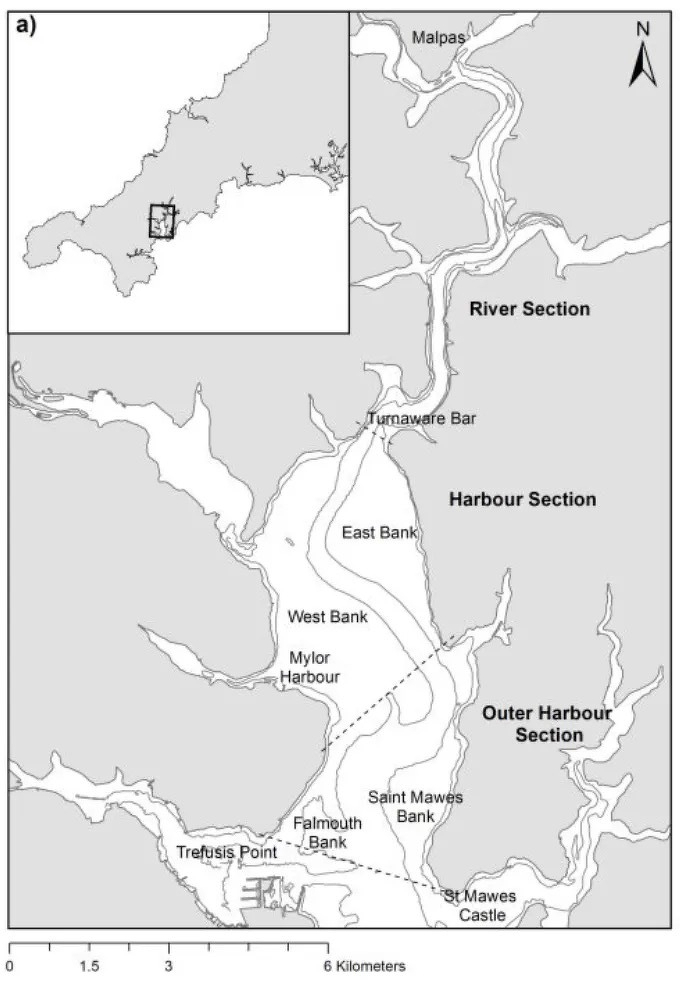 The Carrick Roads
That meant that once again I was able to enjoy seeing one of my favourite sailing craft.
I’m talking about the Fal Oyster Boats, also known as Falmouth Working Boats.
And I’m privileged to be able to see them. Why?
Because it’s the last oyster fishery in Europe to dredge using sail power alone.
And it’s been going on for a while.
The Phoenicians and Romans collected oysters right here thousands of years ago.
By that standard, the present-day oyster boats are a recent addition. They’ve only been going since 1868.
That’s when the Truro Corporation first passed the bylaw that’s still adhered to today.
The terms of its licence states:
“This licence does not extend to any boat while that boat is being propelled by mechanical power”.
It also stipulates when the work can take place.
The season starts at the beginning of October and runs until the end of March. Working time is limited to between 9 am and 3 pm on weekdays, 9 am to 1 pm on Saturdays and not at all on Sundays.
Who said enforcing stability and sustainability is a recent thing?
That there is still a healthy stock of native oysters in the Fal proves it’s worked.
What’s more amazing is that some of the original boats built to ply these waters are still working today.
Take the ‘Evelyn’.
She was built in 1898 on a beach in Restronguet Creek by master shipwright Frank Hitchens.
She’s still afloat and celebrated her 125th anniversary this year. And she isn’t afloat as just a museum piece either. She works the oyster beds in the season and races in the Summer.
Here’s a photo of her chasing down another boat whilst racing past Pendennis Castle in Falmouth. If a 125-year-old boat sailing in front of a castle built by Henry VIII over 450 years ago isn’t living history, I don’t know what is.
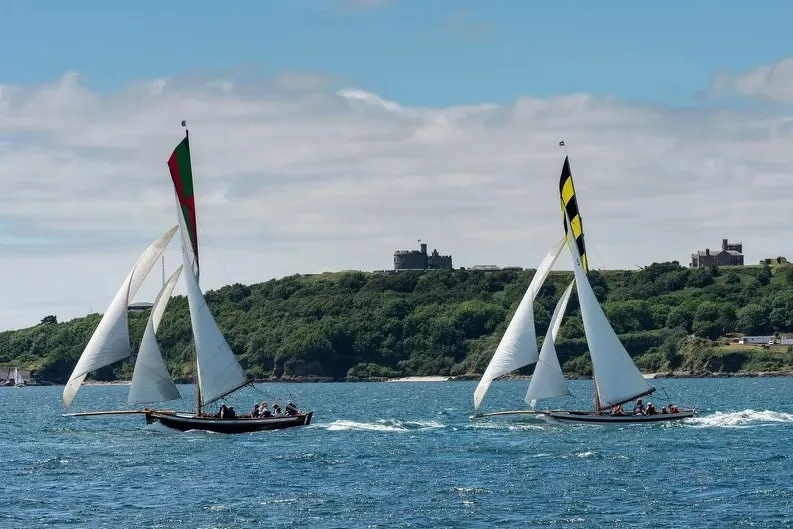 Photo from the Evelyn website
At its height in 1922, there were some 189 oyster boats operating on the Fal. Forty-five of those were sail powered and 144 relied on oars.
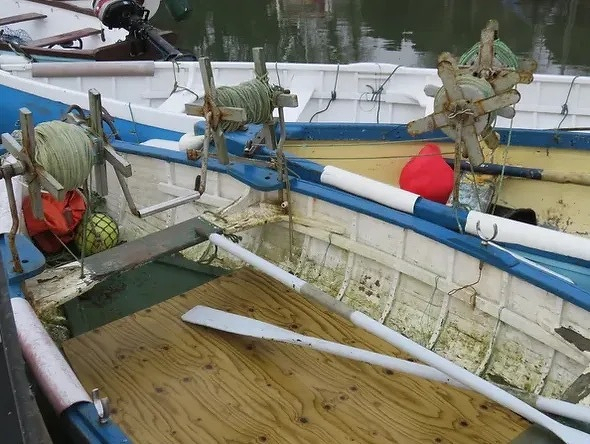
These rowboats were built specifically for the oyster dredging trade, and are known as haul–tow punts.
Usually worked by one person the fishing procedure involves dropping an anchor, rowing away from it, and then hauling the boat back towards it whilst dragging the dredge along the bottom.
The two drums you can see in the photo below control the anchor and dredge.
A survey carried out a few years back showed that there are now just 16 registered working boats and 14 registered haul-tow boats. Of those, it’s thought that only about 6 of the sailboats and 5 of the haul-tow boats are actively working.
On my paddle the other day there were about six out sailing and one haul-tow operating so that seems about right.
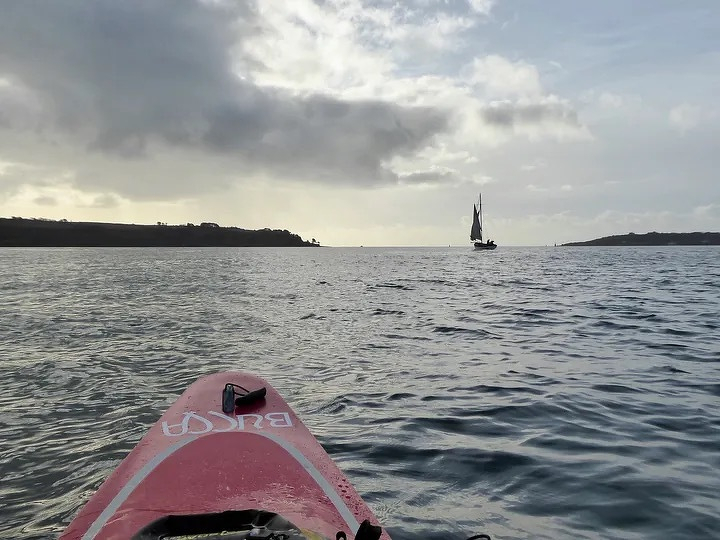
In some ways, it’s remarkable that there were any out there at all. A combination of Brexit and the COVID-19 pandemic all but finished the tradition.
It’s my understanding that more queen scallops (queenies) than oysters are now being dredged. And that storage and processing changes have had to be made to continue exporting to the EU.
I can’t pretend to know much about the intricacies of running a shellfish business.
I just know that the romantic sailor in me appreciates the beauty of these boats and the skill of the skippers who sail them.
Handling a heavy 28ft gaff-rigged sailboat solo when the breeze is fresh is not easy. That they do it whilst hauling dredges and sorting the catch is more impressive still.
The way they control things is to ‘scandalise’ the main sail to reduce the speed of the boat. In effect, they ‘heave to’. This means the boat can be left to look after herself leaving the skipper free to work.
At the end of a run, he then hauls the sail back up, sheets in, and re-positions the boat ready for the next one. That’s hard physical work.
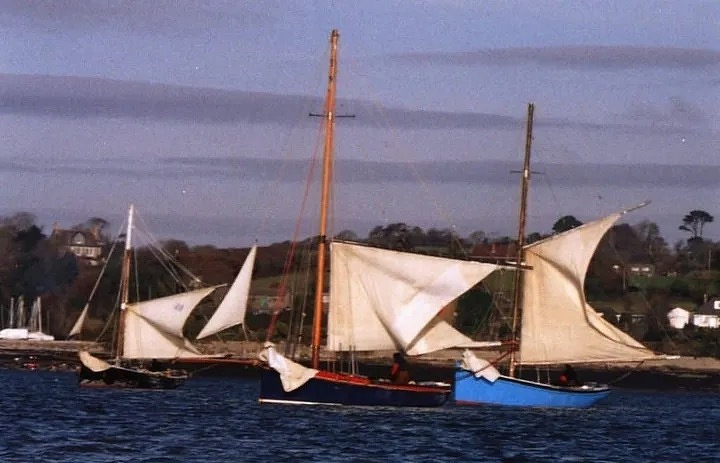 Three working boats with ‘scandalised’ sails
Who knows how much longer these skills will survive? The industry is resilient but there may come a time when its activity becomes financially unsustainable.
Whatever happens, it looks as if the boats will continue to sail. The Falmouth Working Boats Association has 25 boats registered. Not all are as old as Evelyn, some are even made of GRP.
But they are used. Summer races are regular and competitive.
Hopefully, these wonderful craft will be seen on the waters of the Fal for another 125 years.